
Attics, walls, basements and crawl spaces from the North Shore to Tottenville
Spray Foam Insulation in Staten Island, NY
Cooler top floors in a humid July, warmer rooms in January, and lower levels insulated with flooding in mind. Priced in writing after we look.
- Free on-site estimates
- Written quote showing foam type, thickness and R-value for each area
- Moisture, leaks and flood history checked before anything is covered
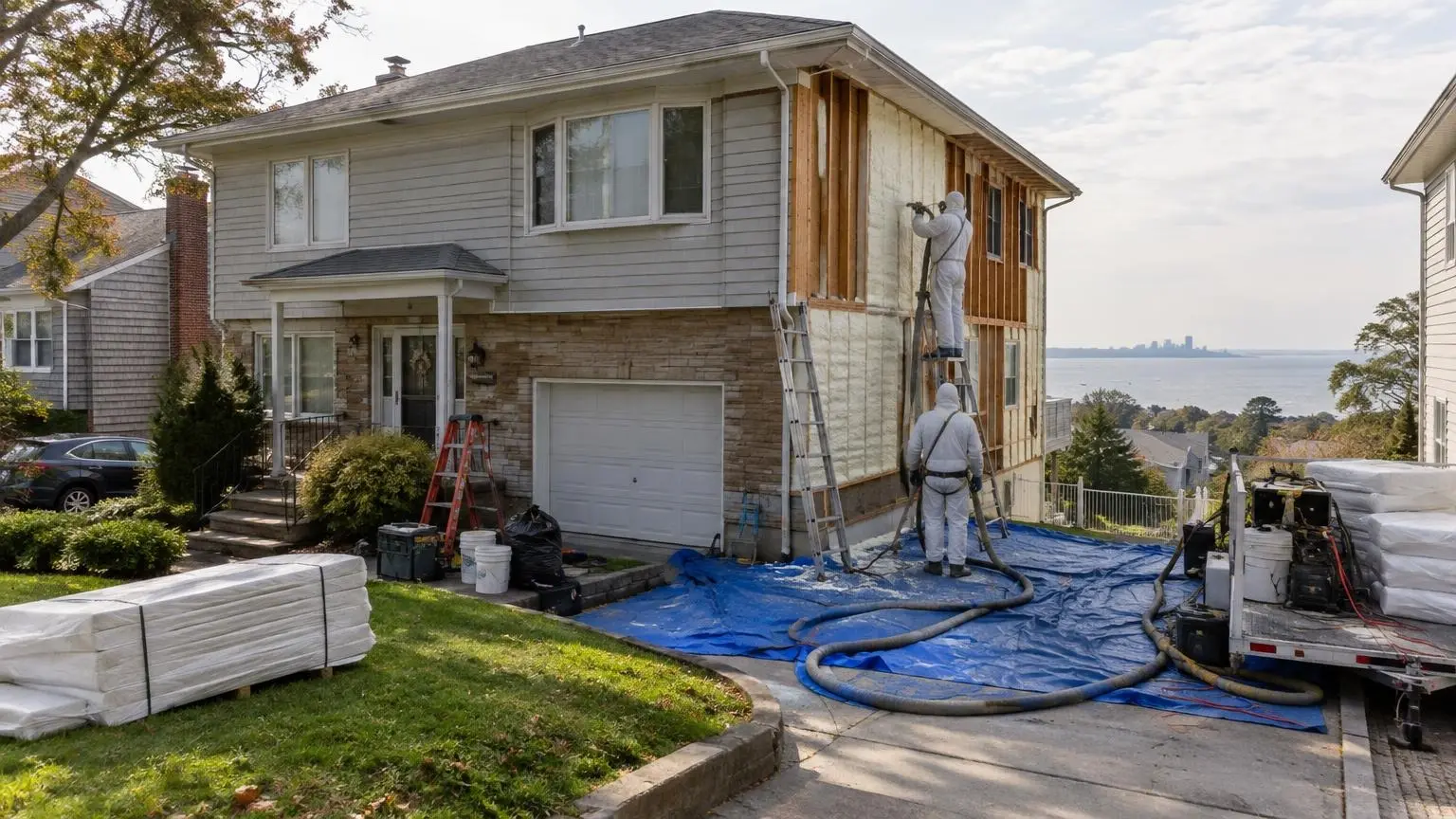
Insulation for Staten Island Houses
Spray foam insulation on Staten Island has two jobs that most places only have one of. It has to keep a house comfortable through humid summers and cold, damp winters, and on much of the island it has to cope with water below the first floor. We air seal and insulate attics, walls, basements, crawl spaces and rim joists across the borough, using closed-cell or open-cell spray foam where it earns its cost and blown-in cellulose or fiberglass where that does the job for less. Every price is written after an on-site visit.
The climate we insulate for
New York City sits in a humid subtropical climate, according to Wikipedia's Climate of New York City article. The 1991-2020 normals for Central Park show a January daily mean of 33.7F, a July daily mean of 77.5F, about 29.8 inches of snow a year and roughly 49.5 inches of precipitation. July and August dew points average close to 62F. In practical terms, that means an attic that bakes all summer, a top floor the air conditioner struggles to cool, and a lot of moisture in the air looking for a cold surface to condense on. Staten Island's own official climate records are kept at Prohibition Park in Westerleigh, but the pattern is the same: warm, sticky summers and winters cold enough to make drafty houses expensive to heat.
What the energy code asks for
The 2025 New York City Energy Conservation Code says Climate Zone 4A applies to all projects in the city. Its residential insulation table for that zone lists R-49 for ceilings; R-30 for wood-frame walls, or R-20 in the cavity plus R-5 continuous, or R-13 plus R-10 continuous; R-30 for floors; and R-15 continuous or R-19 in the cavity for basement and crawl space walls. The same code caps air leakage at 3.0 air changes per hour at 50 pascals. Those numbers apply to new work and renovations that trigger the code, but they are also a fair yardstick for an existing house. Most Staten Island homes built before the 1990s fall short somewhere, usually in the attic and at the rim joist.
Water, flooding and the lower level
Hurricane Sandy hit the island on October 29, 2012. Wikipedia's account of the storm in New York reports at least 21 deaths on Staten Island, a storm surge of 9.56 feet above normal tide near the Kill Van Kull, and the state's highest observed water line, 7.9 feet above ground, on a doorframe in Oakwood. Whole blocks were washed away in Midland Beach, New Dorp and Oakwood Beach. Many houses near the shore have been rebuilt or raised since then, and many lower levels have been gutted and redone.
That history shapes how we insulate below the first floor. FEMA's Technical Bulletin 2 says only Class 4 and Class 5 flood damage-resistant materials are acceptable below the base flood elevation in a special flood hazard area, and it defines those as materials that can take at least 72 hours of contact with floodwater without more than cosmetic repair. If your house is in a mapped flood zone, we check what the rules require for the space before recommending a material, and we talk through closed-cell foam, rigid board and other options with you.
Closed cell vs open cell
Open-cell foam is soft and light. HomeGuide lists it at R-3.5 to R-3.7 per inch. It expands a lot, fills irregular cavities and seals air well, and it dampens sound, which helps in houses near the expressway or a busy road. Water vapor can pass through it, so it needs a moisture plan. Closed-cell foam is dense and rigid at R-5 to R-7 per inch. At normal thickness it slows vapor, absorbs very little water and stiffens the surface it is sprayed on.
On Staten Island we usually reach for closed-cell on rim joists, basement and crawl space walls, the underside of roof decks in cathedral ceilings, and anywhere the space floods or stays damp. Open-cell fits interior walls, above-grade wall cavities and many attic rooflines. On a wide open attic floor, sealing the gaps and blowing in cellulose to depth is often the better value, and we will say so.
Questions to ask insulation contractors
When you call spray foam insulation contractors or insulation companies on Staten Island, a few questions show who has thought about your house. Ask what they will seal before they insulate. Ask which foam they plan for each area and why, and what thickness and R-value the quote shows. Ask how they ventilate during spraying and how long you need to stay out (HomeGuide advises allowing at least 24 hours). Ask what they do with old insulation that is wet or moldy, and how they handle a basement that has flooded before. A quote that lists each area with its own material, thickness and price is easy to compare. Ours does.
Spray foam insulation cost
HomeGuide's 2026 guide puts installed spray foam at $1.50 to $5.00 per square foot: $1.50 to $3.50 for open-cell and $3.00 to $5.00 for closed-cell. It lists rim joists at $2,000 to $2,500, an attic at $3,000 to $8,000 and a whole house at $8,000 to $20,000, and notes that many installers charge a minimum of $1,000 to $2,000 or more. Fixr's figures for existing homes run higher, $3.15 to $7.50 per square foot for existing walls. These are national numbers. On Staten Island, tight attic access in older houses, debris removal after flooding and the need to protect finished rooms can move the total. The written estimate we give you after the visit is what you pay.
Our Services
Six services that cover every part of a Staten Island house, from the attic down to the crawl space.
Spray Foam Insulation
Closed-cell and open-cell foam that insulates and air seals in one layer, chosen for each surface in the house.
Learn more →Attic & Roofline Insulation
Air sealing and insulation for attic floors, kneewalls, rooflines and cathedral ceilings, aimed at hot summer top floors and winter heat loss.
Learn more →Basement & Crawl Space Insulation
Rim joists, foundation walls and crawl spaces insulated and sealed, with flood history and moisture checked before any material goes in.
Learn more →Wall Insulation
Insulation for existing closed walls and for open walls during a renovation or rebuild, from dense-pack and injection to spray foam.
Learn more →Blown-In Insulation
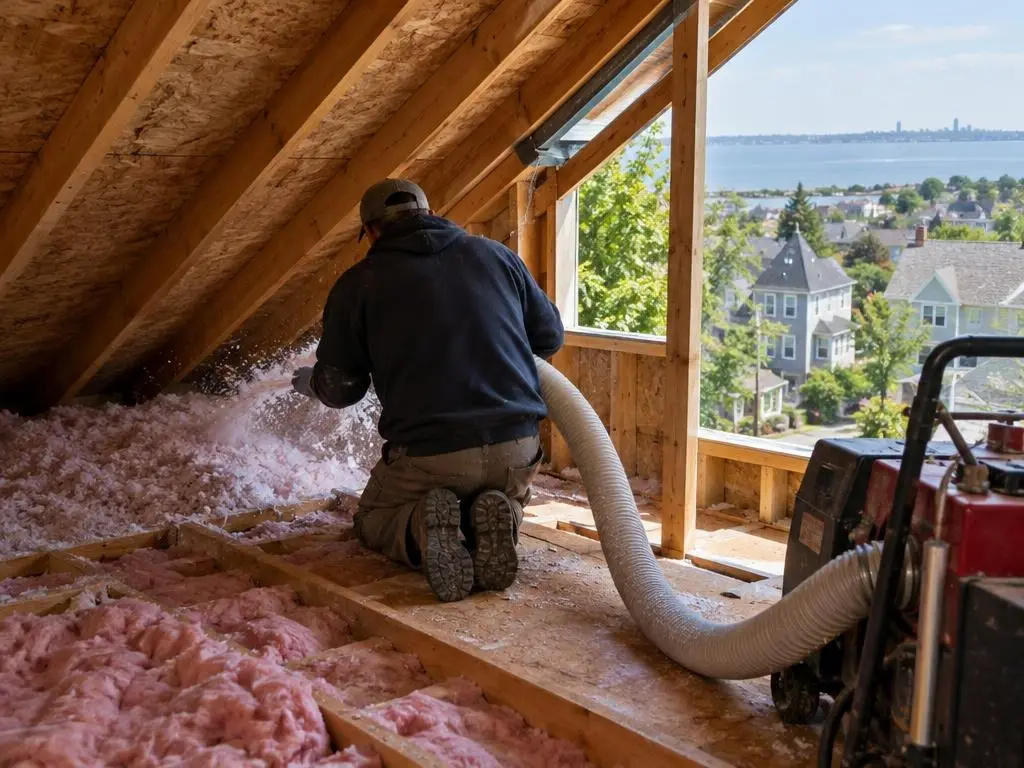
Loose-fill cellulose or fiberglass blown into attic floors and closed spaces, the economical way to reach depth.
Learn more →Insulation Removal & Replacement
Old, wet, moldy or contaminated insulation taken out and replaced with a sealed, properly insulated space.
Learn more →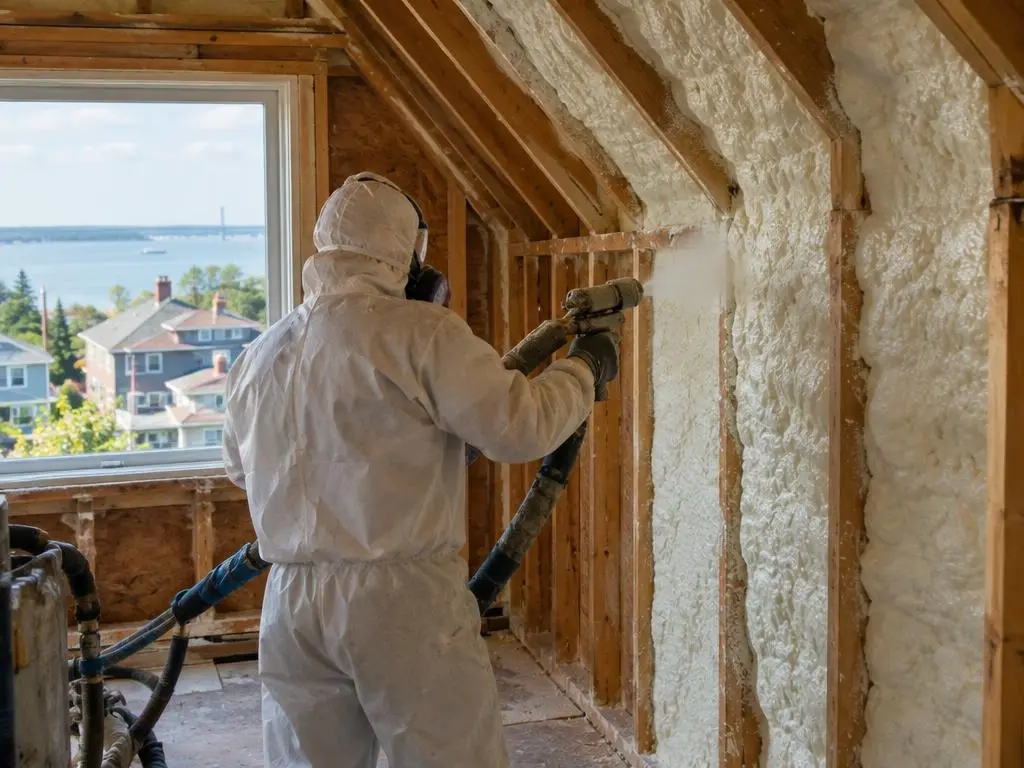
Neighborhoods We Serve
We work in every part of the island. North Shore neighborhoods like St. George, Stapleton, Port Richmond and West Brighton hold many of the borough's 19th-century frame houses, with balloon framing, plaster walls and little or no wall insulation. The Mid-Island, from Westerleigh and Willowbrook to New Springville, Todt Hill and Dongan Hills, filled in with single-family homes after the Verrazzano-Narrows Bridge opened in 1964. The East and South Shore, from South Beach, Midland Beach and New Dorp to Great Kills, Eltingville, Annadale, Prince's Bay, Rossville, Charleston and Tottenville, mixes old beach bungalows, postwar capes, 1970s to 1990s development and newer townhouses, and much of it sits low enough that flooding is part of the conversation. Pick your neighborhood below to see what we look for there.
- Spray Foam Insulation in Staten Island, NY
- Spray Foam Insulation in St. George, NY
- Spray Foam Insulation in Stapleton, NY
- Spray Foam Insulation in Port Richmond, NY
- Spray Foam Insulation in West Brighton, NY
- Spray Foam Insulation in Westerleigh, NY
- Spray Foam Insulation in Willowbrook, NY
- Spray Foam Insulation in New Springville, NY
- Spray Foam Insulation in Todt Hill, NY
- Spray Foam Insulation in Dongan Hills, NY
- Spray Foam Insulation in South Beach, NY
- Spray Foam Insulation in Midland Beach, NY
- Spray Foam Insulation in New Dorp, NY
- Spray Foam Insulation in Oakwood, NY
- Spray Foam Insulation in Great Kills, NY
- Spray Foam Insulation in Eltingville, NY
- Spray Foam Insulation in Annadale, NY
- Spray Foam Insulation in Arden Heights, NY
- Spray Foam Insulation in Prince's Bay, NY
- Spray Foam Insulation in Rossville, NY
- Spray Foam Insulation in Charleston, NY
- Spray Foam Insulation in Tottenville, NY
Why Homeowners Call Spray Foam Insulation Staten Island
We look before we price
Every quote follows a visit to the attic, walls, basement or crawl space. Nothing is priced from a phone call.
Flood history taken seriously
We ask whether the lower level has taken water and check for damp framing before choosing what goes below the first floor.
The cheaper option when it works
If air sealing plus blown-in beats foam on part of the house, the quote shows that option.
Quotes you can line up
Each area lists material, thickness or depth, target R-value and price, so you can compare bids fairly.
Common Questions
How much does spray foam insulation cost on Staten Island?
HomeGuide's national range is $1.50 to $5.00 per square foot installed, with attics at $3,000 to $8,000 and rim joists at $2,000 to $2,500. Access, foam type, thickness and any removal change the total. We give you a written price after seeing the space, and that is the price.
What R-value does New York City require in an attic?
The 2025 NYC Energy Conservation Code places the city in Climate Zone 4A and lists R-49 for ceilings. That applies to new work and renovations covered by the code. For an existing attic, it is a sensible target, and we write the planned R-value on the quote.
Is there a spray foam that is fireproof?
No spray foam is fireproof. Foam plastic insulation generally has to be separated from living space by a thermal barrier such as drywall, and in some attics and crawl spaces an ignition barrier coating is used instead. We plan the covering with the foam so the finished job meets code for that space.
Which spray foam has the highest R-value?
Closed-cell foam, at R-5 to R-7 per inch according to HomeGuide, compared with R-3.5 to R-3.7 for open-cell. That is why closed-cell is used where space is tight, such as rim joists and shallow rafters. Open-cell can still reach the target R-value where the cavity is deep enough.
Can spray foam go in a basement that flooded during Sandy?
Often yes, once the space is dry and any damaged material is gone. Closed-cell foam absorbs very little water, but below the base flood elevation in a mapped flood zone, FEMA's rules limit which materials are acceptable. We check your situation before recommending anything.
What are the downsides of spray foam?
It costs more per square foot than blown-in, it needs the household out of the space while it cures, and it is hard to remove later. It also hides whatever it covers, so leaks and wiring problems have to be dealt with first. Where loose fill does the job for less, we say so.
Do you serve my part of the island?
Yes. We work across Staten Island, North Shore, Mid-Island, East Shore and South Shore. Call (646) 461-2857 and tell us your neighborhood.
Get a Spray Foam Insulation Estimate
Tell us the house and the problem. We will visit, look, and send a written price.